
As live entertainment reaches unprecedented global demand, ticketing distribution trends have evolved from fragmented point-to-point connections into a sophisticated, API-driven ecosystem that's reshaping how venues monetise inventory and how consumers discover unforgettable experiences.
From Fragmentation to Unified Connectivity: The New Distribution Model
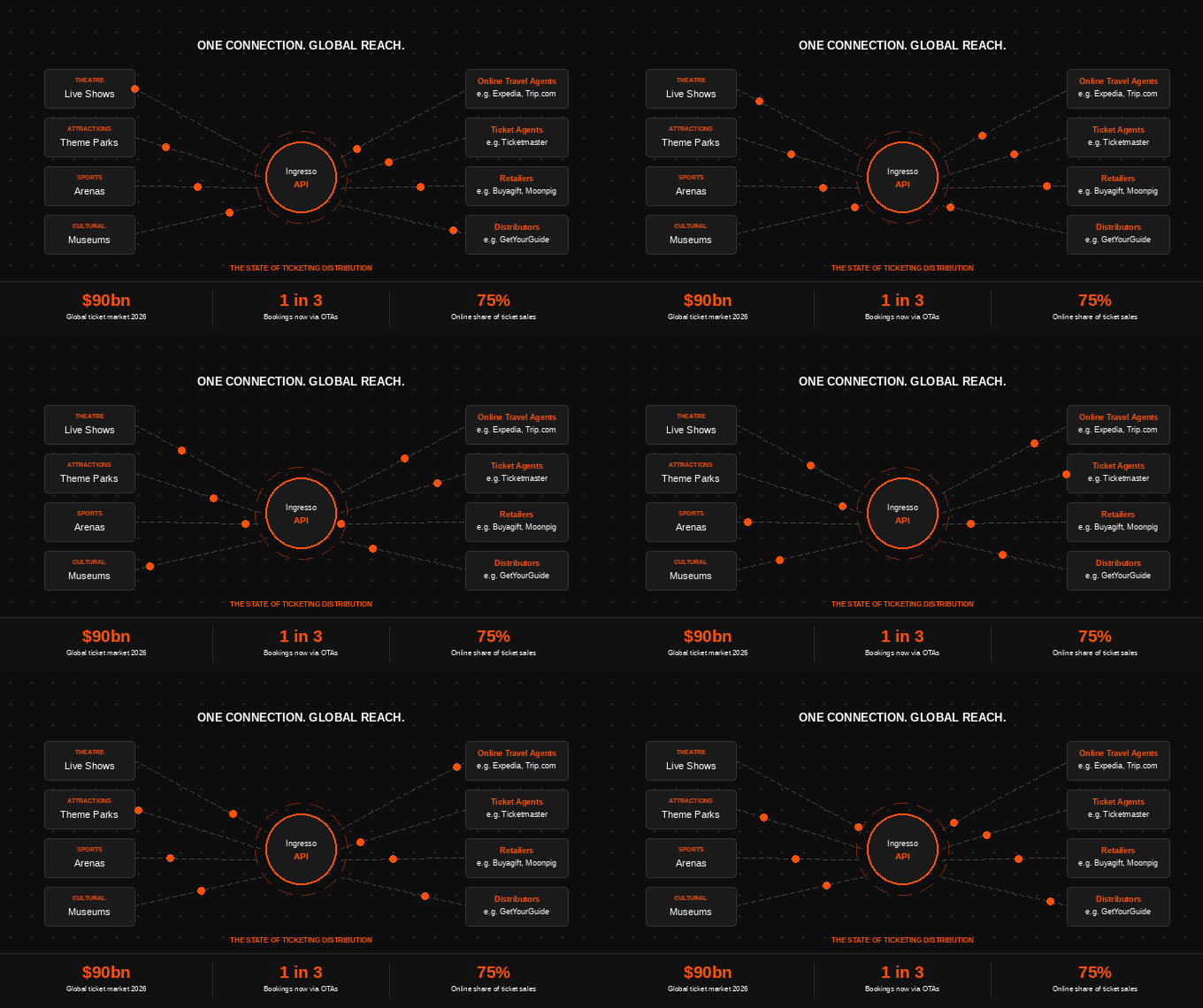
The ticketing landscape has undergone a fundamental transformation. The global ticket market stands at $90 billion in 2026, with projections showing growth to $158 billion by 2035. Within this expansion, travel experiences—attractions, tours, and activities—represent a $53 billion segment growing at a 9.2% CAGR. This isn't just growth; it's one of travel's fastest-moving segments, and it's forcing every player in the distribution chain to rethink how they operate.
What we're witnessing is the end of ticketing distribution as a patchwork of individual connections. The traditional model—where each venue maintained separate integrations with each distributor—has become untenable at scale. When each individual API integration costs $10,000 and requires 4–6 weeks of development time, the mathematics of multi-channel distribution simply doesn't work. For a venue looking to connect to five major OTAs, that's $50,000 and half a year of development before a single ticket is sold.
The shift toward API-first architecture isn't driven by technical preference—it's driven by economic necessity. Venues need access to multiple distribution channels simultaneously. Distributors need reliable, real-time inventory from hundreds or thousands of suppliers. The only way this works at scale is through unified connectivity platforms that eliminate the need for point-to-point integrations. What was once a fragmented web of individual connections is consolidating into a hub-and-spoke model where a single integration unlocks access to an entire distribution network. It's this shift that Ingresso was built around: a single API connection that gives distributors access to global inventory across attractions, live entertainment, sports, and theatre without rebuilding their integration stack.
Real-Time Inventory Is Now the Baseline
Consumer expectations have fundamentally shifted. Online ticket sales now account for 75% of the market, and that digital-first audience expects instant confirmation, live availability, and pricing that reflects real-world demand. Static inventory feeds updated once or twice daily are no longer acceptable—they lead to overbooking, customer frustration, and lost revenue.
We're seeing this play out across both live entertainment and attractions. Live Nation reported revenue topping $25 billion in 2025, up $2 billion year-on-year, driven largely by improved digital distribution and real-time inventory management. On the attractions side, the story is similar: OTAs now capture roughly a third of all experience bookings according to Arival research, and those bookings are happening in real-time.
The technical standard has evolved to match this reality. Modern distribution infrastructure supports live inventory queries, instant booking confirmation, and dynamic pricing that adjusts based on demand, time to event, and channel-specific strategies. Venues that can't support these capabilities are being left behind—not because they lack compelling content, but because their technical infrastructure can't meet distributor requirements. The baseline expectation is no longer 'Can you provide inventory?' but 'Can you provide it in real-time with full transparency and control?'
The Case For Single-Integration Distribution
The economics of distribution have shifted decisively in favour of unified connectivity. Consider the position of a mid-sized venue or attraction looking to expand its digital distribution. Connecting directly to GetYourGuide, Expedia, Booking.com, Viator, and TripAdvisor would require five separate integrations—$50,000 in development costs and roughly six months of engineering time. Then comes ongoing maintenance, version updates, and troubleshooting across five different technical relationships.
This is why we're seeing rapid adoption of platforms that offer single-integration access to multiple distributors. The value proposition is straightforward: integrate once, reach everywhere. For venues, this means faster time-to-market, lower technical overhead, and the ability to add new distribution channels without additional development. For distributors, it means access to a broader catalogue of inventory without the burden of managing dozens, or hundreds, of individual supplier integrations.
Booking.com's re-entry into the attractions market in September 2025 illustrates this perfectly. They didn't build individual connections to 150,000+ attractions across 115 countries—they integrated with FareHarbor's existing network. GetYourGuide, a valued Ingresso partner, which neared €1 billion in revenue in 2025, relies on connectivity platforms to access much of their supplier inventory. The pattern is clear: the industry is consolidating around fewer, more complete, better-maintained connections. Point-to-point integrations still exist, but they're increasingly reserved for the largest suppliers with unique technical requirements. For everyone else, unified connectivity is the path forward.
What Consumers Now Expect From the Booking Experience
Distribution capability is no longer just about moving inventory from point A to point B. It's about delivering the full booking experience through digital channels with the same level of control and interactivity that consumers expect from direct bookings. Interactive seat selection, mobile ticket delivery, and real-time pricing are table stakes for competitive distribution.
We're seeing this particularly in live entertainment, where seat selection drives conversion. Customers want to see exactly where they'll sit, compare options, and make informed decisions. We consistently hear from distributors that offering interactive seat maps via API results in higher conversion rates than customer journeys limited to best-available inventory. These requirements are exactly why Ingresso has stayed ahead of the curve, building interactive seat maps that can be ingested and displayed seamlessly via API
Mobile delivery adds another layer of expectation. Consumers expect tickets delivered instantly to their devices, complete with barcodes, event information, and wayfinding. This requires distribution infrastructure that supports real-time ticket generation and mobile-optimised delivery formats. The venues and distributors investing in these capabilities are winning market share from those still relying on email confirmations and PDF attachments. The distribution channel is becoming the experience channel.
Scale Without Complexity: What Good Distribution Looks Like in 2026
Scale is no longer a luxury; it's a requirement for competitive distribution. Venues need access to international audiences. Distributors need global inventory depth. But traditional approaches to building that scale—individual partnerships, market-by-market expansion, one integration at a time—create operational complexity that grows exponentially.
The data shows where the momentum is headed. OTAs capturing a third of experience bookings. GetYourGuide crossing €1 billion in revenue. Booking.com adding 150,000+ attractions in a single integration. Direct bookings aren't disappearing, but they're declining relative to OTA bookings, particularly for international visitors and last-minute purchases.
For venues, the implication is clear: being absent from major OTA distribution networks means leaving revenue on the table. For distributors, managing multiple fragmented integrations means spending engineering resources on infrastructure rather than conversion optimisation and customer experience.
The venues and distributors succeeding in this environment are those that recognise distribution as a strategic capability, not a tactical add-on. They're investing in infrastructure that supports real-time connectivity, mobile-first experiences, and the ability to scale across channels and geographies. If you're still evaluating how your current approach to connectivity positions you for the next phase of market growth, find out what capabilities the Ingresso API can unlock for you.

Channel Management Solutions: Key Takeaways from UKInbound

One API. Every Category: The Case For A Unified Inventory Strategy